

Backlit Scoreboard Banners & Stadium Signage in Macedonia, OH
A scoreboard banner is the single most-photographed piece of signage a school owns, and usually the most neglected.
It sits in the background of every game photo, every highlight clip and every parent's phone for an entire season. When it has gone chalky and the edges have started to fray, that is what is in the background instead.
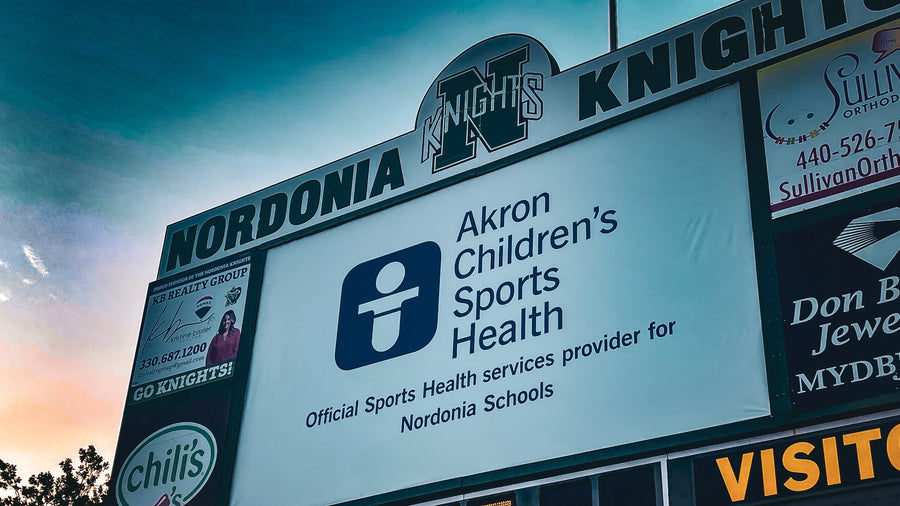
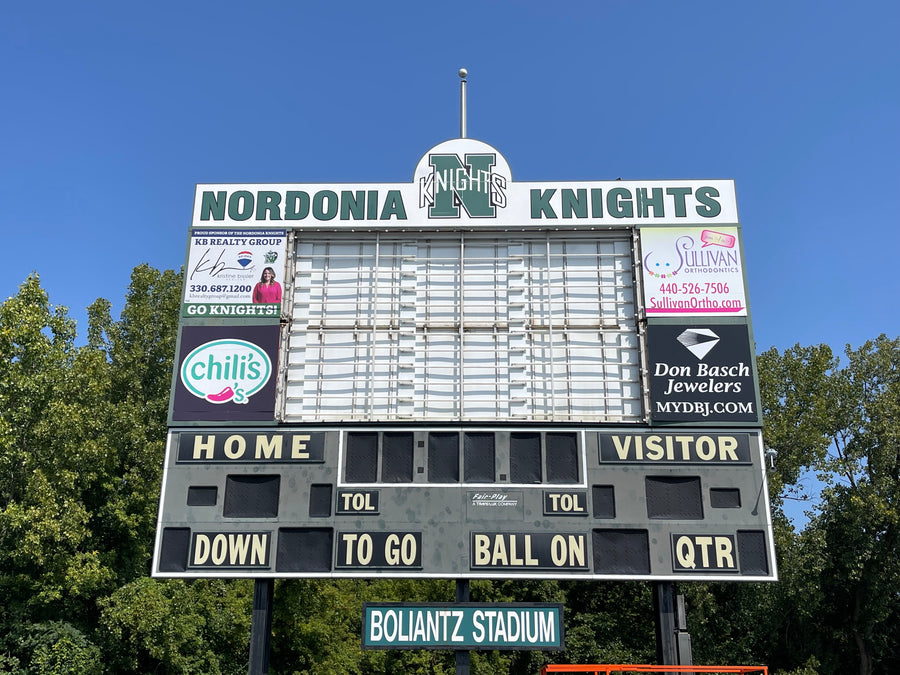

Replacing a faded scoreboard banner at Nordonia High School in Macedonia. The old panel comes out, the frame gets checked, the new 13 oz banner goes in.
Backlit is a different product
This is the detail that gets missed most often, and it costs schools money.
A standard banner is printed to be seen with light falling on it. A backlit scoreboard has light coming through it from behind. Print a standard banner and light it from behind and you get a washed-out, patchy, unreadable panel — the ink that looked solid in daylight goes transparent.
Backlit work is printed at higher ink density on material chosen to diffuse the light behind it evenly. It costs more per square foot than a standard banner, and it is the difference between a scoreboard that reads at night and one that does not.
If your scoreboard is lit from within, say so when you ask for a price. If you are not sure, tell us the make and we will work it out.
13 oz, 18 oz, and mesh
13 oz scrim vinyl is the standard for stadium and scoreboard work. It has a woven scrim through it that stops a tear from running, it handles tension without distorting, and it takes Ohio weather for several seasons.
18 oz blockout is heavier, opaque through the middle so nothing shows through from behind, and worth it for double-sided panels or anywhere the banner takes real abuse.
Mesh has perforations that let wind through, and it belongs on fence runs and exposed elevations where a solid banner would act as a sail. It is not the right choice for a backlit scoreboard — the holes that let the wind through also let the light through.
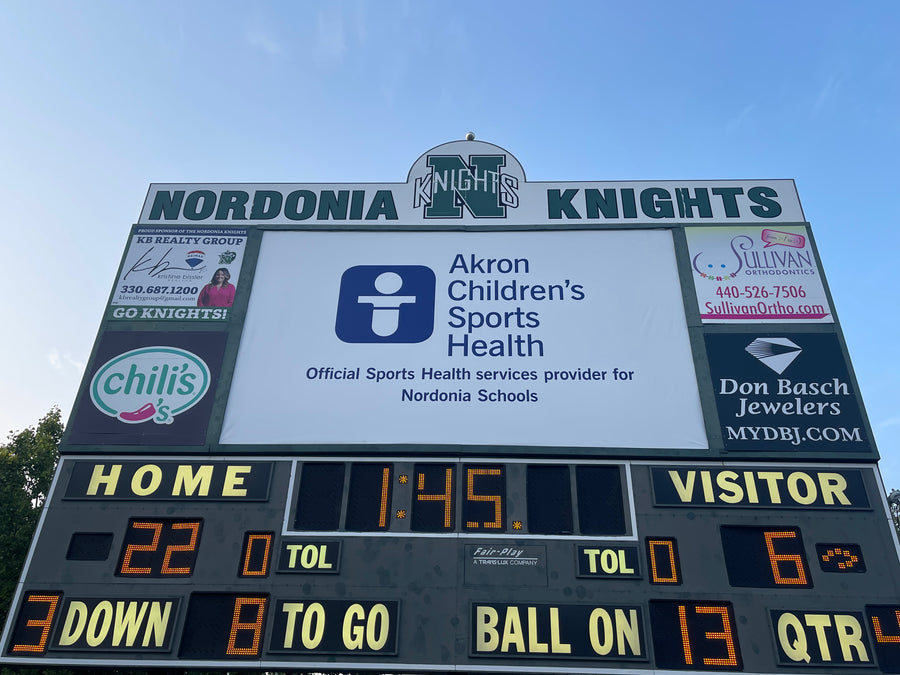
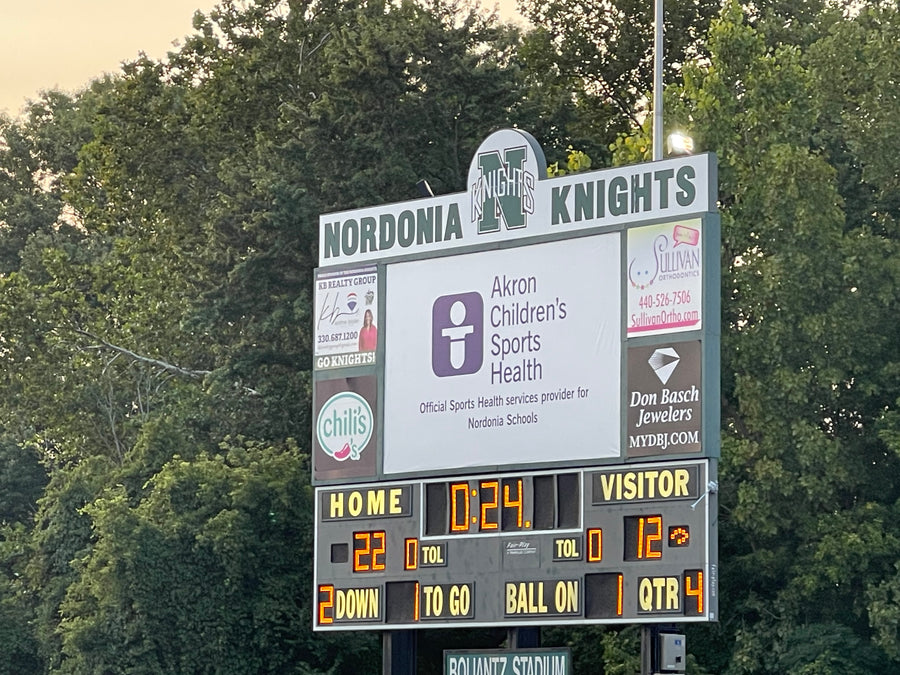

The finished panel, tensioned evenly across the frame so it stays flat through a season of wind.
Attachment is what fails first
Banners rarely fail in the middle. They fail at the edge, at a grommet, in February, in a wind nobody was expecting.
Which is why the finishing matters as much as the print: hemmed on all four sides, grommets at proper spacing rather than just at the corners, reinforced corners, and the right hardware for the frame — bungees and tensioners that give a little rather than rigid ties that concentrate every gust into one grommet hole.
A scoreboard frame also has its own attachment points, and they are not always where you would put them. Getting a banner made to the frame instead of to the opening is worth the extra measurement.
Two years later, that is exactly what failed
The paragraph above was written before August 2026. Then a windstorm came through Macedonia and took out the attachment on this very scoreboard.
The banner did not tear first. The grips did. The scoreboard came with its own banner-retention system, and after years of sun and weather those grips had gone brittle. When the wind got under the panel several of them let go at once, the load concentrated on the few that were still holding, and the banner tore.
That is the ordinary way a scoreboard banner dies, and the ordinary fix is new grips and a new panel.
Except the grips were no longer available. The original banner system for this scoreboard is no longer supported — no parts, no spares, nothing equivalent to order. The board itself was perfectly serviceable. It lit, it kept score, it had years left in it. The system holding its graphic had simply aged out of existence.


The old panel comes out and the frame goes on. Scoreboard work means a lift, every time.
So rather than improvise a repair around a system that no longer exists, we retrofitted the scoreboard with our own: CreativStretch, a tensioned aluminum frame that mounts around the banner opening and carries the graphic on its own hardware, independent of whatever the manufacturer originally supplied. The frame went on first, then a new banner built to that frame.
This board is backlit on fluorescent tubes, which makes two things matter more than they would on an LED board. The tubes sit at fixed positions behind the panel, so the material has to diffuse evenly or you see them through the graphic. And the frame has to sit clear of the light path rather than cutting across it, or it casts a line on the face.


A spring, a grommet, a rail. That is the whole attachment — and the whole point.
It cost more than a replacement panel would have. The district was told that before we started, and the reason is worth stating plainly: the money went into the frame, not the graphic, and the frame is the part that does not need doing again.
What the school gets from here on
Changing the graphic no longer requires us, a parts order, or any particular skill. The new panel hooks onto the frame at the grommets. That is the entire operation. Someone on the maintenance staff who has never hung a banner can do it, and a sponsor change that used to be a project is now an afternoon.
That last part matters more than it sounds, because this panel is sponsored. A scoreboard is one of the most straightforward sponsorship assets a district owns, and sponsors rotate. A frame that makes every future changeover cheap is worth more to a district that sells the space than one that simply will not break again.


Finished, tensioned flat, and no longer dependent on a system nobody makes.
If your scoreboard has outlived the company that built it, that is a solvable problem. How a scoreboard banner retrofit works →
Measure the frame, not the old banner
The old banner has stretched. Every banner does. Ordering a replacement to the dimensions of the thing you are taking down is how you end up with something that will not tension flat.
Measure the frame opening and the attachment point spacing, or have us come and do it — on-site measurement across Northeast Ohio is free, and for a scoreboard it is worth the visit.
Common questions
How long does a stadium banner last?
Several seasons for 13 oz vinyl in Ohio weather. Direct all-day sun and constant wind shorten it; the failure point is usually the attachment, not the print.
Can you install it, or do we have to?
We install. Scoreboard work often needs a lift and it is not a job for maintenance staff on a ladder.
What about the off-season?
Taking a banner down over the winter roughly doubles its life. If you want to do that, ask for grommet spacing and hardware that make it easy to remove and rehang.
Can a sponsor pay for it?
Commonly, yes — scoreboard panels are one of the most straightforward sponsorship assets a district has, and a business paying for the banner gets the most-seen signage on the property.
Stadium and athletic signage across Northeast Ohio
We design, produce and install scoreboard banners, backlit scoreboard panels, fence wraps, mesh banners, wall padding graphics, gym wall graphics and record boards for schools and athletic programs in Macedonia, Nordonia, Hudson, Twinsburg, Stow, Akron and across the region.
Everything we do in Macedonia, Ohio →
Request a quote or call 330.968.0678. On-site measurement across Northeast Ohio is free.
Related: Sign company in Macedonia · Athletic and facility branding · North Royalton athletic facility case study · Scoreboard graphics for Copley · Installation and project management