

Experiential Graphics & Brick Wall Vinyl in Shaker Heights, OH
Akron Children's Hospital was opening a new location near the Van Aken District in Shaker Heights. The campaign announcing it did not go on the new building. It went into the district itself, because that is where the families already were on a Saturday.
Van Aken is a retail and food district — coffee, restaurants, places to sit and talk. So the work came out as two 52-inch googly eyes on a brick wall, forty more sets hidden through the district as a scavenger hunt for children, and 3,750 printed cup sleeves carrying Akron Children's branding and a pair of googly eyes with room for a child to draw their own face. Finishing the hunt earned a free hot chocolate and one of the sleeves.
Designed, produced and installed by DG Creativ, including the printed sleeves.
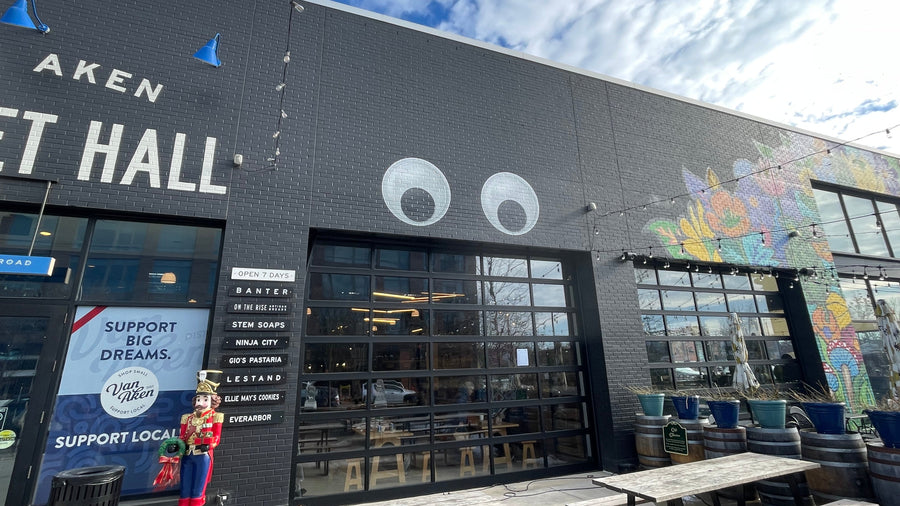


Two 52-inch graphics printed on BrickWrap and installed on brick in the district.
Why brick is the hard part
A graphic on a flat sealed wall is straightforward. A graphic on brick is not.
Standard wall vinyl will not hold on masonry — brick, concrete and stucco are low-energy, porous and irregular, and a normal adhesive lifts at the edges within weeks. The material here is a textured-surface film with an aggressive adhesive built for exactly that, and it has to be worked into the mortar lines during installation so the graphic follows the wall instead of bridging across it.
Get that wrong and the piece looks like a sticker on a building. Get it right and it looks like it was painted on.
The other half of the specification is removal. This was a campaign, in a retail district, on buildings that belong to the district rather than to the client — and it had to come off cleanly at the end without taking the brickwork with it. High-tack and surface-safe are competing requirements, and which one wins is decided by how long the graphic needs to stay up. That is why we ask before quoting rather than after.


Placements through the district, positioned at child height as stops on the scavenger hunt.
Three formats, one delivery schedule
The brief was not "put our logo on the building." It was to announce a new location to the families most likely to use it, in a place they were already going, and to make the announcement something a child would actually take part in.
That is why the work spans three completely different production problems. The oversized brick graphics do the visibility job from across the district. The forty smaller placements turn a walk through it into a hunt. And the printed cup sleeves — a different press, a different material, a different finishing process entirely — are the thing a child takes home and draws on.
None of those three on its own would have done it, and running them through three suppliers would have meant three schedules and three people to chase when one slipped.


Scale and placement detail across the installation.
What experiential work needs that ordinary signage does not
A permanent sign gets designed once and lives on a known surface. An activation does neither.
The surfaces are whatever the site has — brick, glass, painted metal, terrazzo, planters, all in the same campaign, all needing different materials.
The date is immovable. An opening, an event, a season. There is no version of this where the graphics arrive the following week.
Somebody else owns the building. Landlord and property-management approval is part of the job, and removability is usually a condition of it.
There is usually something printed as well as something installed. Sleeves, cards, handouts, giveaways. They are a separate production job on the same deadline, and they are the part people take with them.
It has to come down. Which means removal is a line in the quote, not an afterthought.
If you are planning something similar
Four things are worth settling before anyone quotes it:
- What the surfaces actually are. Brick, block, stucco, sealed drywall, glass and metal all take different materials. A quote given without knowing is a guess.
- How long it needs to last. A six-week activation and a three-year installation are different specifications and different prices.
- Who installs it. Large-format graphics on irregular surfaces are not a self-install job, and a printer who subcontracts installation adds a hand-off where things go wrong.
- Whether it has to come off cleanly, which on a leased or historic building is usually non-negotiable.
Common questions
Can printed graphics go directly onto a brick wall?
Yes, with a textured-surface vinyl made for low-energy substrates. Standard wall vinyl will not hold on masonry.
How big can one graphic be?
Printable width is typically 52 inches per panel. Larger pieces are tiled and aligned on site.
Do they come off again?
They are removable, but brick is porous and removal takes longer than on a smooth sealed surface. Tell us how long it needs to stay up before we specify the material.
Who does the installation?
We do. Print and install are the same company, so there is no coordination between a printer and a separate installer.
Can you handle printed collateral alongside the installation?
Yes — the 3,750 cup sleeves on this project are the example. Running the printed pieces and the installed graphics through one supplier puts them on one schedule.
Experiential graphics across Northeast Ohio
We print and install experiential, environmental and brick-surface graphics across Shaker Heights, Cleveland, Akron and the rest of Northeast Ohio — retail districts, healthcare, schools, museums and public spaces. Agencies bring us the concept; we work out whether it will actually stick, and then install it.
Request a quote or call 330.968.0678. On-site measurement across Northeast Ohio is free.
Related: Sign company in Shaker Heights · Sign company in Cleveland · Wall graphics and murals · Window graphics, perf and frosted film · Akron Children's Hospital case study · Installation and project management